
- หน้าแรก
- สินค้าของเรา
-
ข้อมูลทางเทคนิค
-
Strain gage
-
Strain Gage Basic Information
- What's a Strain Gage
- Types of Strain Gages
- Self-Temperature-Compensation Gages (SELCOM Gages)
- Major Properties of KYOWA Strain Gages
- Strain gage bonding installation procedure
- Strain Gage Wiring System
- Principles of Strain Gages
- How to Select Strain Gages
- Strain Gages with Pre-attached Lead-wire Cables
- Strain Measurement
-
Measurement Knowledge
- Misalignment Effect of Bonding Strain Gage
- Generating Calibration Value Based on Tip
- Resistance Change of Strain Gages
- Strain Gage Bonding Procedure
- Compensation formulas for strain gage
- Countermeasures against Failure in Initial Balance
- Influence of Insulation Resistance
- Temperature Effect on Lead Wire with 2-wire
- Compensation Methods of Temperature Effect
-
Strain Gage Basic Information
-
Transducers
- Transducers
- Basic information of strain gage type sensors
-
Measurement Knowledge
- Sensitivity Decrease due to Cable Extension
- Equation to Calculate Centrifugal Acceleration
- Connection to Calculate Average Output Voltage
- How to Obtain Proper Rated Capacity of Load Cell
- TEDS
- Advantages of Remote-Sensing Method
- Graphs to Obtain Power or Work
- Installation of Load Cell to Hopper or Tanks
- How to Obtain Accuracy of Load Cell-Based
- Measuring Instruments
- Videos for how to use KYOWA products
- Unit Conversion Table
- Glossary
- FAQ
-
Strain gage
- ดาวน์โหลด
- ข่าวสาร l กิจกรรม
- บทความ
- เกี่ยวกับเรา
- ติดต่อเรา
- ลงทะเบียน


ข้อมูลทางเทคนิค
How to Obtain Proper Rated Capacity of Load Cell
If the weighing object is a low-viscosity liquid showing less horizontal movement with both the tare and content and initiating less impact,
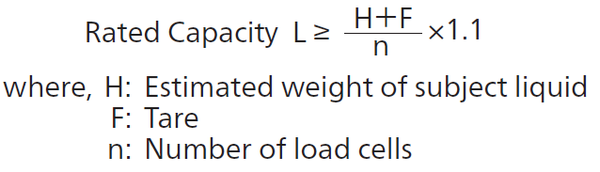
If there is vibration, use a higher factor in a range of 1.1 to 1.5 according to the degree of acceleration.
If the weighing object is powder or high-viscosity liquid, increase the above-mentioned factor to 1.3. If there is vibration, use a higher factor in a range of 1.3 to 1.5.
If the weighing object is powder or high-viscosity liquid, increase the above-mentioned factor to 1.3. If there is vibration, use a higher factor in a range of 1.3 to 1.5.
If the weighing object shows less horizontal movement with both the content and tare but initiates large impact,

If the weighing object shows horizontal movement with both the content and tare and initiates large impact,

Increase the factor to 1.7 if impact is repeatedly applied. Equations above are on the supposition that the load is evenly allotted to all load cells used in a multiple number. If the load is unevenly allotted, determine the rated capacity considering the load given to the load cell to which the biggest burden is allotted.
In the case of a hanging application, it is recommended to select a rated capacity 2 times higher than obtained through equations above, to ensure safe operation.
In the case of a hanging application, it is recommended to select a rated capacity 2 times higher than obtained through equations above, to ensure safe operation.
เราใช้คุกกี้เพื่อปรับปรุงไซต์ของเราและประสบการณ์ของคุณ อ่านเพิ่มเติมได้ที่ นโยบายความเป็นส่วนตัว